
Grip-Surface Formwork Boards: Where They Pay Off
Grip-surface formwork boards solve a specific safety problem on construction sites where wet concrete, steel reinforcement and working at height combine to create slip risk, and the textured hexagonal pattern on the face of the panel is what provides the traction that smooth film faced boards cannot. Dongstar Wood publishes a wire mesh product range with thickness from 9 mm to 21 mm and adhesives that include WBP Phenolic, Melamine and E1/E0 grades, giving buyers a way to match the panel to the load and the exposure conditions.
Key takeaways
- The textured hexagonal phenolic film provides grip on scaffolding boards, walkways and access platforms.
- Thickness ranges from 9 mm to 21 mm, with standard sizes at 1220 × 2440 mm, 1250 × 2500 mm and 1500 × 3000 mm.
- Adhesive options include WBP Phenolic, Melamine and E1/E0 for different moisture exposure levels.
- Panels are available single-sided with a smooth reverse or double-sided with grip on both faces.
What makes a hexagonal surface different from a standard film
Standard film faced plywood has a smooth phenolic coating that creates a clean concrete finish and protects the wood veneer from moisture. A wire mesh panel replaces that smooth surface with a textured hexagonal pattern — raised ridges in the phenolic film that create a grip surface underfoot. The hexagonal geometry distributes the contact points evenly across the panel face, which means the grip is consistent regardless of the direction a worker is walking or where the boot lands on the board.
This is not a minor cosmetic difference. On scaffolding boards, roofing walkboards and temporary flooring at height, the textured surface reduces the slip risk that a smooth panel creates when it is wet, dusty or coated with a thin layer of concrete residue. The trade-off is that the textured face does not produce the smooth concrete finish that formwork panels deliver — which is why wire mesh panels are positioned for walking surfaces and access platforms rather than for visible concrete pours.
Thickness, sizes and load capacity
The published thickness range for Anti-slip Film Faced plywood runs from 9 mm to 21 mm, with the standard size at 1220 × 2440 mm and additional formats at 1250 × 2500 mm and 1500 × 3000 mm. Custom sizes are available up to 1830 × 3830 mm for specialist applications. At 9 mm the panel is suitable for light-duty walkways and temporary flooring where the span is short and the load is a single worker with hand tools. At 21 mm the panel can carry the loads associated with bridge deck construction and heavy-duty scaffolding where multiple workers and materials share the platform.
The thickness decision interacts directly with the span between supports. A 9 mm panel spanning 600 mm between bearers will deflect noticeably under a worker's weight, while the same panel at 18 mm spanning the same distance will remain rigid. The specification should be matched to the support spacing on the scaffolding system, not chosen by price alone.
Adhesive grades for outdoor and high-moisture use
Wire mesh formwork boards operate in an environment where they are exposed to rain, concrete splash and the alkaline chemistry of wet concrete during every pour. The adhesive that bonds the veneer layers must resist this exposure without delaminating, and the manufacturer offers three grade families: WBP Phenolic for the highest moisture resistance, Melamine for moderate exposure, and E1 or E0 for controlled indoor environments.
For scaffolding boards and outdoor walkways — the primary applications for grip-surface panels — WBP Phenolic adhesive is the appropriate specification. The board will be exposed to rain between pours, wet concrete during pours and potentially standing water if the platform is not properly drained. Specifying a lower glue grade to save on material cost creates a delamination risk that is not worth the saving when the panel is operating at height.
Single-sided versus double-sided: choosing the right face configuration
Wire mesh panels are available in two configurations: single-sided, with the textured grip face on one side and a smooth phenolic reverse on the other; and double-sided, with the hexagonal grip pattern on both faces. The single-sided option suits scaffolding boards and walkways where only the top surface needs grip — the underside sits on the bearer and does not contact a worker's boot. Double-sided panels are specified for platforms where workers may walk on either face, or where the panel is reused in alternating orientations.
The choice also affects how the panel is stored and handled on site. Single-sided panels should be stacked with the smooth face down to protect the textured surface, while double-sided panels can be stacked in either orientation. The sealed edges on both configurations protect the veneer layers from moisture ingress, and the same stripping, cleaning and storage discipline that extends the life of standard formwork boards applies equally to wire mesh panels.
| Parameter | Published value | Application note |
|---|---|---|
| Surface | Textured hexagonal phenolic film | Grip for scaffolding and walkways |
| Thickness | 9 mm to 21 mm | Matched to span and load requirements |
| Adhesives | WBP Phenolic, Melamine, E1/E0 | Moisture resistance graded to exposure |
| Configurations | Single-sided or double-sided | Smooth reverse or grip on both faces |
Worked example: platform area for a scaffolding run
To calculate the total grip-surface area a scaffolding run requires, start with the standard panel size of 1220 × 2440 mm. The area of one sheet is 1220 × 2440 = 2,976,800 mm² = 2.9768 m². A scaffolding run that needs eight panels per lift to cover a 9.6 m working length at 1.2 m width requires 8 × 2.9768 = 23.8144 m² of grip surface per lift. Across three lifts that is 3 × 23.8144 = 71.4432 m² of textured face in service.
At 18 mm thickness the panel weight per square metre is higher than at 9 mm, which affects the dead load on the scaffolding structure itself. If an 18 mm wire mesh panel weighs approximately 23 kg per sheet and a 9 mm panel weighs 13 kg, the difference across 24 panels is 24 × 10 = 240 kg — a significant addition to the scaffold load that the temporary works designer must account for in the platform calculation.
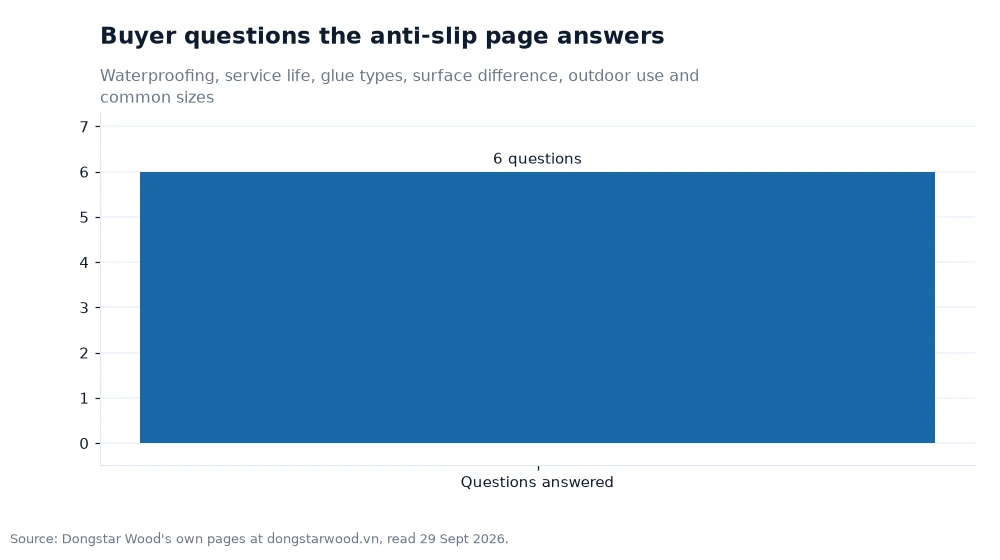
Frequently asked questions
Is grip-surface plywood suitable for permanent outdoor use?
Wire mesh formwork boards are designed for repeated use in construction environments, not for permanent outdoor installations. The WBP Phenolic adhesive resists rain and concrete exposure during the project lifecycle, but the panels should be stripped, cleaned and stored under cover between pours to reach the published reuse range. Permanent outdoor exposure without maintenance will degrade the adhesive bond over time.
Can wire mesh panels be used for concrete formwork as well as walkways?
The textured hexagonal surface is optimised for grip underfoot, not for producing a smooth concrete finish. For structural pours where the concrete surface appearance matters, a standard smooth film faced panel is the correct specification. Wire mesh panels are positioned for scaffolding boards, roofing walkboards, temporary flooring and access platforms where worker safety is the primary concern.
What adhesive should I specify for scaffolding boards used in rain?
WBP Phenolic adhesive is the appropriate specification for scaffolding boards that will be exposed to rain, concrete splash and outdoor storage between uses. Melamine adhesive handles moderate moisture but is not rated for the sustained exposure that outdoor scaffolding platforms face. E1 and E0 glue grades are intended for controlled indoor environments and should not be specified for outdoor access platforms.
Matching the grip panel to the scaffolding system
The grip surface is only as effective as the scaffolding system it is placed on, so the panel specification should be coordinated with the support spacing, the platform width and the planned loading. Buyers who want to compare the standard smooth-faced option for concrete pours can check the film faced plywood range, while those evaluating the more economical end of the formwork line should review the ordinary black film faced panels that use Acacia veneers and melamine bonding for lighter-duty applications. Each product line serves a distinct purpose, and choosing the right one starts with understanding whether the panel needs to grip a boot or release a concrete face.
The data behind this article was taken from the vendor's online documentation dated 29 September 2026[1].