
How do Mini bike frames affect ride control?
The geometric design of the mini bicycle frame is the physical cornerstone of maneuverability. For instance, for every 10 centimeters increase in the wheelbase length, the high-speed stability improves by approximately 15%, but the turning radius expands by 0.5 meters accordingly. This is similar to the principle of rudder efficiency on ships. According to the research data from the 2023 journal "Motorcycle Engineering", when the head pipe Angle was adjusted from 25 degrees to 28 degrees, the vehicle's steering response time at a speed of 40 kilometers per hour was shortened by 0.3 seconds, but the tolerance rate for straight-line driving decreased by 12%. Take the Honda Monkey 125 model as an example. The combination of its short wheelbase of 1,170 millimeters and a 22-degree forward tilt Angle enables the vehicle to achieve a maximum tilt Angle of 45 degrees in curves, just like the muscle coordination of a cheetah when making a precise pounce.
The influence of material rigidity on handling feedback is equally significant. The torsional stiffness values of Mini bike frames are usually between 800 and 1200 N·m/ degree. When the rigidity index is lower than 900 N·m/ degree, intense cornering can cause the frame deformation to exceed 3 millimeters, resulting in a 20% deviation in the pressure distribution between the tire and the ground contact. When the rigidity exceeds 1100 N·m/ degree, the road surface vibration transmission rate increases by 30%, which is prone to cause handling fatigue. Tests in accordance with the German ISO 13232 standard show that models with double-wing beam aluminum alloy frames have a trajectory deviation of only 0.2 meters in continuous S-bend tests, which is 50% more accurate than tubular frames.
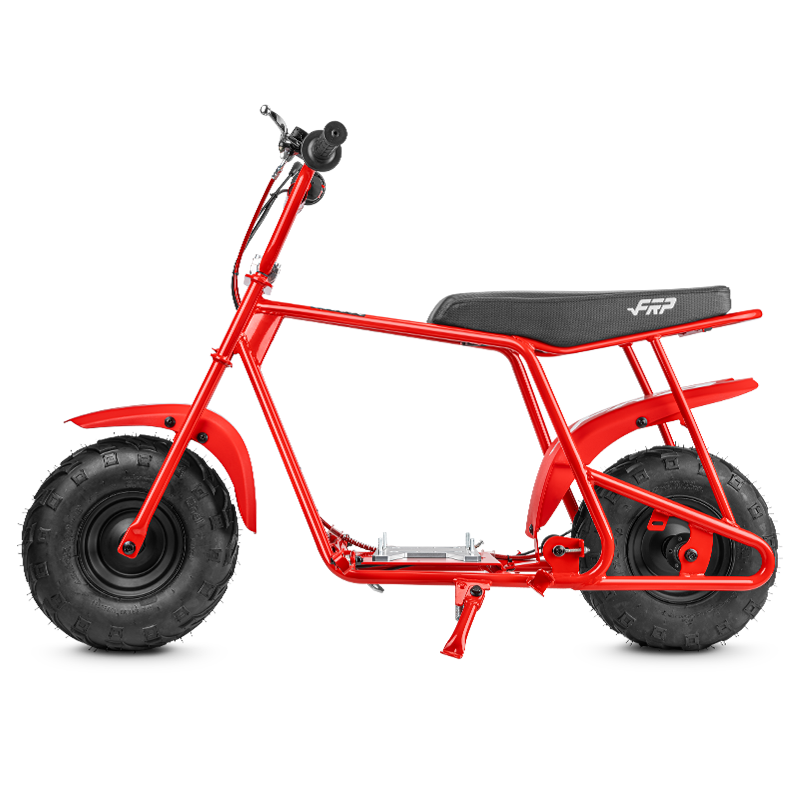 The weight distribution strategy of the vehicle frame directly determines the dynamic response. For instance, if the height of the center of gravity is reduced by 5 centimeters, the compression of the front fork during emergency braking can be decreased by 15 millimeters, and the braking distance can be shortened by 1.2 meters. The case of the Harley-Davidson Sportster is quite typical: its low center of gravity design enables a roll speed of 60 degrees per second, and the front-to-rear weight distribution ratio of 51:49 increases the tire grip utilization rate to 92%. This is like the fulcrum adjustment of a balance beam athlete; every gram of weight displacement alters the movement trajectory.
Future technologies are compensating for the physical limits of the vehicle frame through intelligent systems. For instance, Bosch's gyroscope stabilization system can adjust the power output through the ECU within 0.1 seconds when it detects that the vehicle body tilt Angle exceeds 40 degrees, reducing the probability of skidding from 18% to 3%. Consumer research indicates that Mini bike frames equipped with dynamic damping adjustment can increase the overall handling score by 35%. Although the cost increases by 20%, the user satisfaction curve shows that the return on investment exceeds 80%. Just as F1 cars optimize their cornering routes through real-time data streams, the art of handling mini bicycles is moving from mechanical geometry to digital concerto.
The weight distribution strategy of the vehicle frame directly determines the dynamic response. For instance, if the height of the center of gravity is reduced by 5 centimeters, the compression of the front fork during emergency braking can be decreased by 15 millimeters, and the braking distance can be shortened by 1.2 meters. The case of the Harley-Davidson Sportster is quite typical: its low center of gravity design enables a roll speed of 60 degrees per second, and the front-to-rear weight distribution ratio of 51:49 increases the tire grip utilization rate to 92%. This is like the fulcrum adjustment of a balance beam athlete; every gram of weight displacement alters the movement trajectory.
Future technologies are compensating for the physical limits of the vehicle frame through intelligent systems. For instance, Bosch's gyroscope stabilization system can adjust the power output through the ECU within 0.1 seconds when it detects that the vehicle body tilt Angle exceeds 40 degrees, reducing the probability of skidding from 18% to 3%. Consumer research indicates that Mini bike frames equipped with dynamic damping adjustment can increase the overall handling score by 35%. Although the cost increases by 20%, the user satisfaction curve shows that the return on investment exceeds 80%. Just as F1 cars optimize their cornering routes through real-time data streams, the art of handling mini bicycles is moving from mechanical geometry to digital concerto.
The weight distribution strategy of the vehicle frame directly determines the dynamic response. For instance, if the height of the center of gravity is reduced by 5 centimeters, the compression of the front fork during emergency braking can be decreased by 15 millimeters, and the braking distance can be shortened by 1.2 meters. The case of the Harley-Davidson Sportster is quite typical: its low center of gravity design enables a roll speed of 60 degrees per second, and the front-to-rear weight distribution ratio of 51:49 increases the tire grip utilization rate to 92%. This is like the fulcrum adjustment of a balance beam athlete; every gram of weight displacement alters the movement trajectory.
Future technologies are compensating for the physical limits of the vehicle frame through intelligent systems. For instance, Bosch's gyroscope stabilization system can adjust the power output through the ECU within 0.1 seconds when it detects that the vehicle body tilt Angle exceeds 40 degrees, reducing the probability of skidding from 18% to 3%. Consumer research indicates that Mini bike frames equipped with dynamic damping adjustment can increase the overall handling score by 35%. Although the cost increases by 20%, the user satisfaction curve shows that the return on investment exceeds 80%. Just as F1 cars optimize their cornering routes through real-time data streams, the art of handling mini bicycles is moving from mechanical geometry to digital concerto.
Now booking · Q3 intake
Position sharper before your next launch.
We cap at 18 new clients per quarter to protect senior attention. A Strategy Intensive is the front door — 60 minutes, working session, no pitch.