
What Premium Fragrance Manufacturing Means for a Spa or Hotel Line
Premium fragrance manufacturing is a set of enforceable choices, not a price tier: higher concentrate, documented ingredients, deeper development and stricter batch control. A spa or hotel buyer can only claim premium if the factory is contractually bound to those choices, so the buying question is never “is this factory premium” but “which premium choices are in my specification”. Most of the difference between a premium line and a standard one is decided before the first sample, in the brief and the agreement. The checklist below is ordered the way a project actually runs, so it can be used as a working document rather than a reading list.
Key takeaways
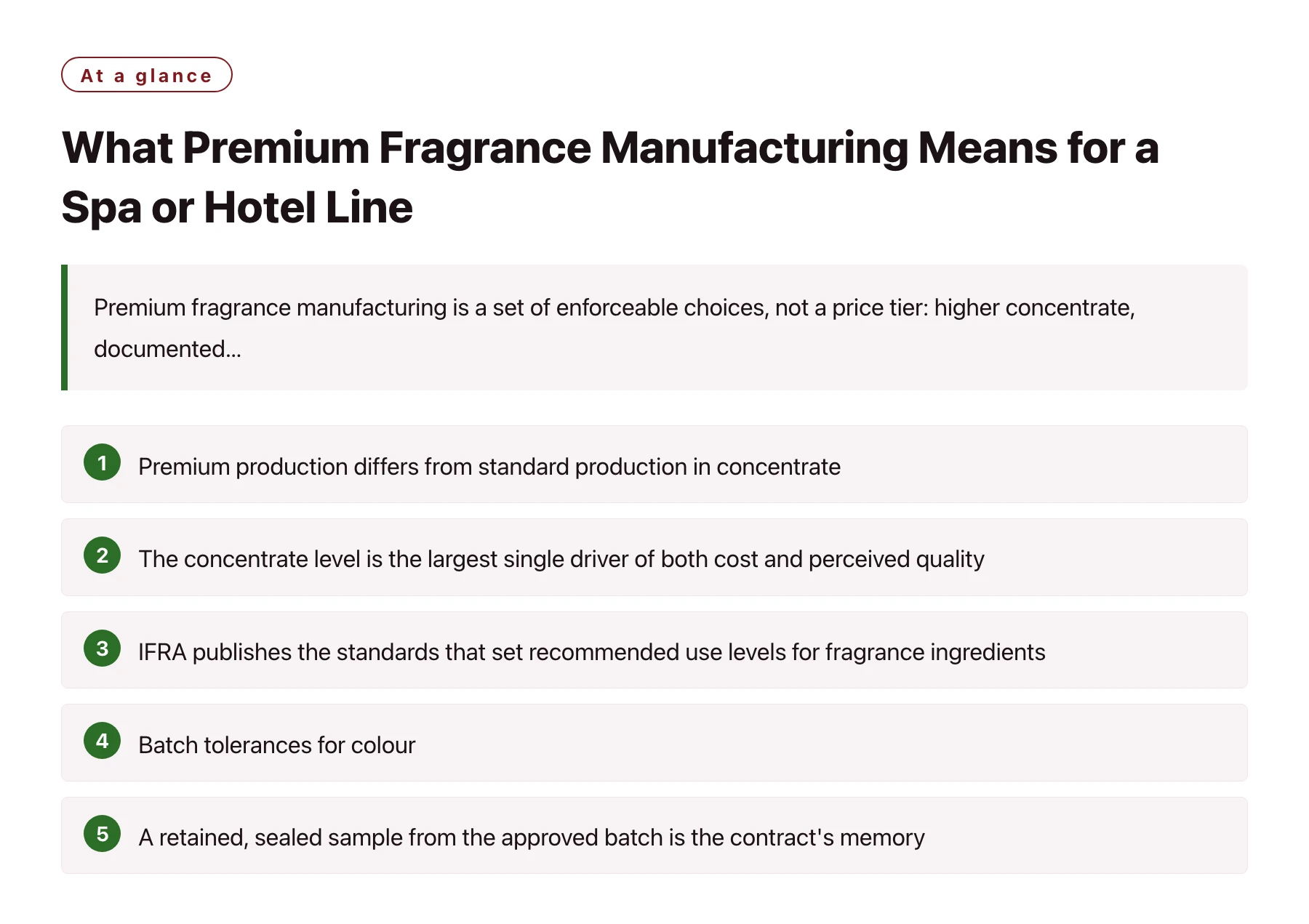
- Premium production differs from standard production in concentrate, ingredient documentation, development depth and batch tolerance — four items that belong in the specification, not in the sales material.
- The concentrate level is the largest single driver of both cost and perceived quality, so it should be fixed in the brief before any price is discussed.
- IFRA publishes the standards that set recommended use levels for fragrance ingredients, and a premium line usually carries the conformity documentation to prove it.
- Batch tolerances for colour, odour, fill weight and specific gravity must be written down, because premium is only meaningful if every batch matches the approved reference.
- A retained, sealed sample from the approved batch is the contract's memory; without it, later disagreements fall back on memory and photographs.
Buying fragrance for a spa or hotel is different from buying for a retail brand in one important way: the product is part of an experience, evaluated by a guest who will never see the marketing story. A signature scent that drifts between batches is not a quality complaint, it is a broken stay. That puts a premium on consistency, which is a manufacturing property, not a marketing one.
This article walks through what actually changes when a brief says premium, in the order a project runs: specification, development, sample approval and production control.
What changes when a brief says premium
The word premium has no fixed meaning in manufacturing; it becomes concrete only when translated into specification choices. The four choices that matter most are the concentrate level, the ingredient list, the depth of development and the batch tolerance the factory must hold.
Concentration and composition
The same fragrance can sit at very different concentrations — extrait, eau de parfum, eau de toilette — and the concentration defines both performance and cost more than almost any other decision [3]. For a spa line the right level is usually not the strongest one but the level that performs in the format: a room diffuser, a body wash and an eau de parfum carry very different amounts of concentrate. Whatever the format, the percentage belongs in the specification, because it is the line item a factory can quietly lower.
Ingredient documentation
The fragrance houses that supply the industry invest heavily in ingredient research and in securing scarce natural materials; Givaudan, for example, describes a research operation built around ingredient science and naturals [1]. A premium buyer should expect the same seriousness from its own supplier: a documented raw material list, with the naturals you care about traceable to a source rather than just a name on a label.
Safety and conformity
IFRA publishes the standards library that sets recommended use levels for fragrance ingredients, and any serious manufacturer works to it [2]. Premium does not require more safety than the law, but it usually requires proof: conformity statements, restricted-material declarations and a compliance pack that is part of the programme rather than an invoice line at the end.
Premium versus standard production
| Consideration | Standard production | Premium production |
|---|---|---|
| Concentrate level | Kept low to protect unit cost | Specified in the contract, format by format |
| Ingredient list | Mainstream materials, often pre-blended | Documented raw materials, scarce naturals possible |
| Development depth | Library accords, few round-trips | Custom accord, several brief–sample rounds |
| Batch control | A release check per batch | Retained reference, full batch records, tight tolerances |
| Documentation | Certificate pack on request | Compliance pack built into the programme |
| If a run drifts | Negotiated case by case | Written tolerance and defined rework |
Read the last two rows together. A factory that holds a written tolerance and can show you the batch record of a previous run is describing a system; a factory that only offers certificates is describing a wish.
The premium buyer's checklist
- Fix the concentrate levelDecide the percentage and the performance window — throw, longevity, feel on skin — before anyone mentions price, and put the number in the brief.
- List the materials you will not tradeRestricted or controversial ingredients, plus the naturals you need proof of sourcing for. The shorter the list, the easier the project; the point is to make it explicit.
- Ask for the compliance pack in the first meetingConformity statements and destination-market documentation belong to the brief stage, not the invoice stage.
- Set batch tolerances in writingColour, odour, fill weight and specific gravity ranges the factory must hold on every run, including what counts as acceptable.
- Appoint a retained referenceA sealed sample of the approved batch, dated and numbered, held by both parties. It is the only neutral referee later arguments can use.
- Verify the operation, not the brochureA tour, or at least a documented walkthrough of scope and quality systems, separates a real premium operation from a marketing claim.
Premium is what the contract says, not what the sales page says. Every item on this checklist should survive a question from a quality auditor; if it cannot, it was not premium in the first place.
Choosing the partner by how it controls the work
When the positioning is the product, the choice of premium fragrance production partner is a specification decision before it is a purchasing decision: the partner's control systems decide whether your signature scent is the same scent in batch one and batch fifty. The factory's answers to the checklist above tell you more in one meeting than a week of reading its website.
Spa and hotel launches routinely combine fine fragrance, bath amenities and a room diffuser in one programme. That is where one-stop fragrance manufacturing earns its keep: the categories sit under one quality regime and one set of batch records, which is exactly the trail an auditor wants to follow.
Experience the house before you hire it
There is also a less formal check worth doing. A manufacturer that keeps an exhibition of its craft, such as the scent museum operated beside the factory in Guangzhou, gives a buyer a firsthand read on how seriously the company takes smell as a discipline — and a visit to the immersive scent museum calibrates your own brief better than any slideshow can.
Sources
- Givaudan —— One of the largest fragrance and flavour houses; public material on fragrance creation, ingredient portfolio and market segments.
- IFRA Standards Library (International Fragrance Association) —— The IFRA Standards Library lists the restrictions the fragrance industry applies to individual fragrance ingredients, based on safety assessments; it is the reference point for compliant fragrance formulation.
- Wikipedia: Perfume —— An encyclopaedic overview of perfume covering definitions, history, the note structure of a fragrance and concentration terminology (background reference only).
Frequently asked questions
What actually makes a fragrance premium?
In manufacturing terms it is a specific set of choices: a defined concentrate level, documented ingredients, deeper development and tighter batch tolerances. None of them are automatic; each has to be specified and then contractually held.
Do spa and hotel lines need a higher concentrate?
Not necessarily. Higher concentrate means more performance per application, but a body wash and a room diffuser need different levels. What matters is that the level is specified per format and matched to the product's real use.
How do I verify a supplier's premium claims?
Ask for the batch record of a previous run, the conformity statements for the ingredients, and the written tolerances the factory holds. Claims live in the brochure; these items live in the system.
Is a retained reference sample really necessary?
Yes. Photographs, emails and memory all degrade. A sealed, dated sample of the approved batch held by both parties is the only durable record of what was approved.
How many development rounds should a premium brief include?
Agree the number in advance rather than letting it float. Two to four rounds is a common range; the important thing is that the round count and the change procedure are written down, so the project cannot expand silently.
Position sharper before your next launch.
We cap at 18 new clients per quarter to protect senior attention. A Strategy Intensive is the front door — 60 minutes, working session, no pitch.